
Research
My current research focus is in protoplanetary disks and the chemistry of planet formation. I am interested in connecting disk chemistry to the physics of disk structure and evolution.
Externally Irradiated Disk Chemistry: A JWST MIRI Case Study of Proplyds in NGC 1977
Planet formation is influenced by the chemical and structural properties of protoplanetary disks. While past observations have focused on nearby disks in low-mass star-forming regions, most stars form in clusters where external ultraviolet radiation from nearby massive stars influences disk chemistry. Using mid-infrared observations from JWST MIRI, we investigate the chemical composition of seven externally irradiated disks located in NGC 1977, tracing an irradiation regime representative of the typical star-forming environment.
Look out for Zhou et al. 2026, in prep, and Booth, Zhou et al. 2026 in review!
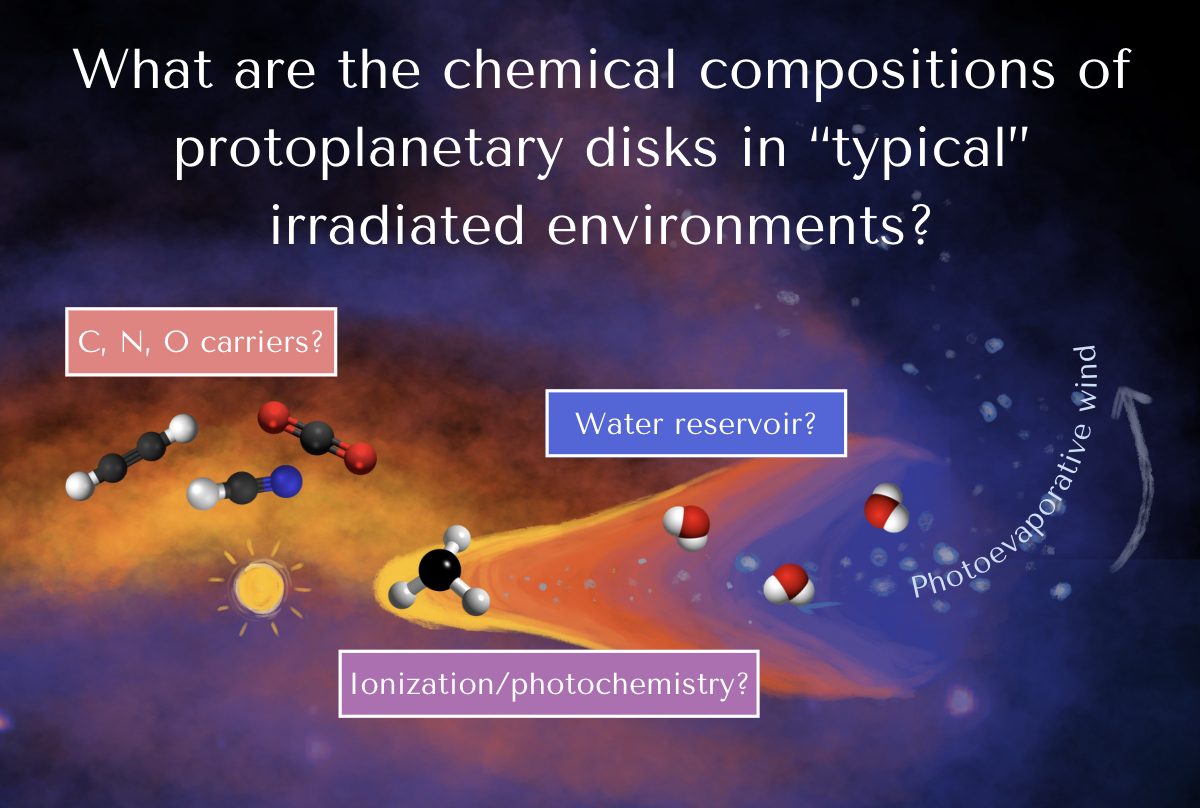 This illustration highlights the impacts of external photoevaporation on pebble drift and irradiation of the upper disk layers, which can in turn impact the water reservoir, abundances of C/N/O carriers, and ionization/photochemistry in the inner disk.
Icy Volatile Enhancements in Evolving Protoplanetary Disks: The Role of Entrapment
Molecular species in evolving protoplanetary disks are redistributed by a myriad of interdependent processes occurring on similar timescales. Within the first ~0.5 Myr, models considering viscous diffusion, advection, drift, desorption, and adsorption result in some volatile ices building up relative to water ice beyond their snowlines, as the outer disk is desiccated by drift and desorption. Building on the results of Yunerman et al. 2026, we are updating these models to incorporate new laboratory experiments of multicomponent ices that mimic the complex composition of those observed in protostellar clouds and at disk surfaces. These predictions for the evolving molecular distributions in protoplanetary disk ices can inform the expected compositions of comets and gas giant atmospheres.
Look out for Yunerman, Zhou, et al. 2026, in prep!
Competitive Entrapment of Hypervolatiles in Interstellar and Cometary Water Ice Analogs
The distribution of chemical species in protoplanetary disks around young stars, especially their division between gas and solid phases, fundamentally shapes the composition of future planets and planetesimals. This distribution is likely affected by entrapment, a mechanism whereby volatile species are mechanically or chemically bound within a less volatile ice. In this study, we experimentally investigate the entrapment efficiencies of four hypervolatiles (CH4, CO, N2, and Ar) in multicomponent water ice mixtures deposited at different temperatures and mixture ratios. These experiments suggest that relative entrapment efficiencies are mainly regulated by small differences in binding energies to the ice matrix, though competition for the best sites also influences entrapment in more concentrated ices. We use these results to better inform interpretations of hypervolatile observations in comets and related objects.
Download Zhou et al. 2024 (PDF)
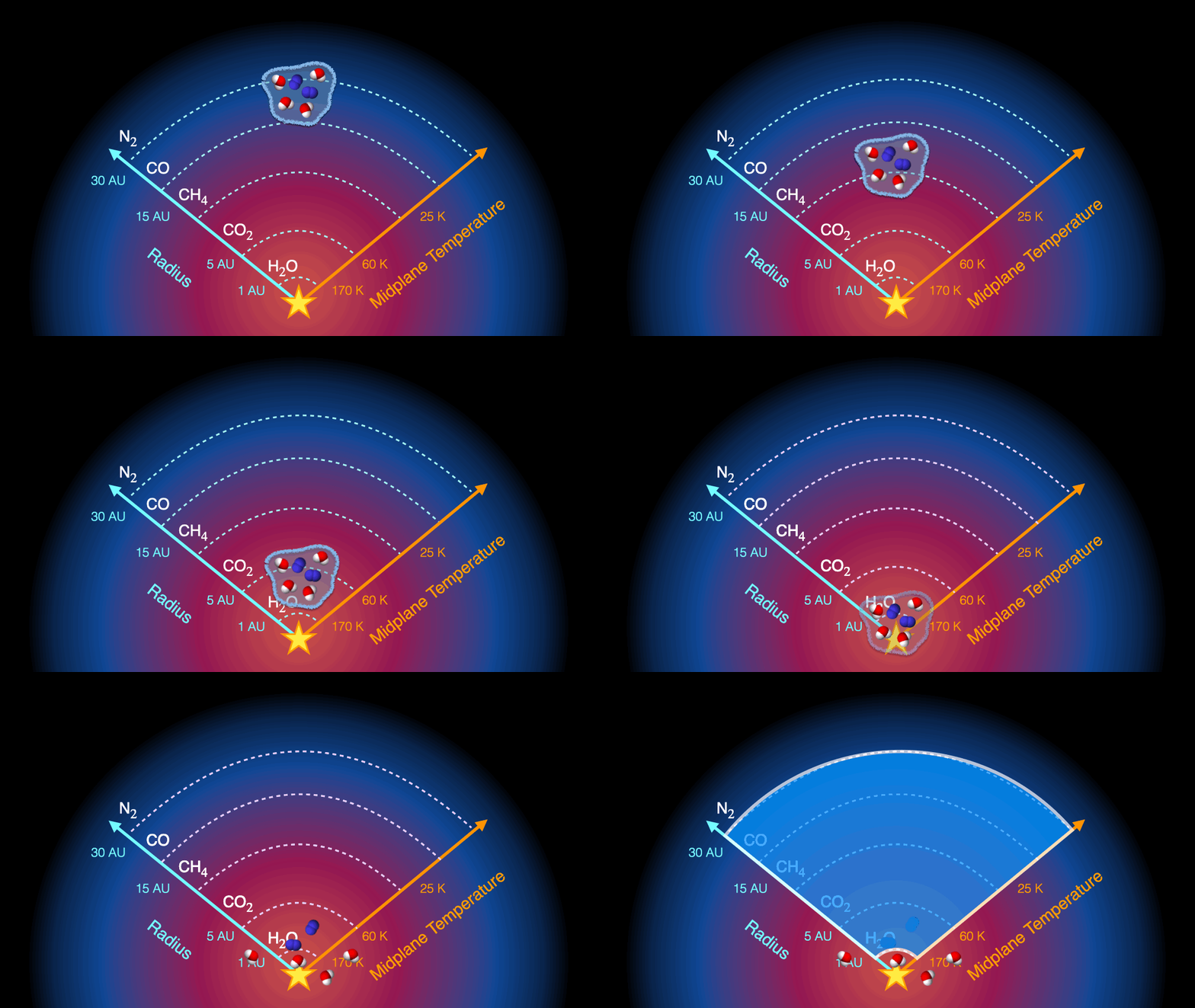 Volatile molecules can be entrapped within less volatile matrices in mixed ices. In this example, N2 is entrapped within water, and it remains in the solid phase up to the water snowline.
Previous Work
Ghost in the Machine: Characterizing the Viaspec Binary Transmission Diffraction Grating
My undergraduate senior thesis focused on testing a type of diffraction grating that could improve spectrograph performance but has not yet been used widely in astrophysics: binary transmission diffraction gratings. The primary motivation for this work was to optimize the performance of the spectrograph for the Via Project, which will perform an all-sky spectroscopic survey of Milky Way halo stars to characterize dark matter. We constructed a spectrograph and characterized stray light features from the grating, concluding that these features will not impact Via’s performance.
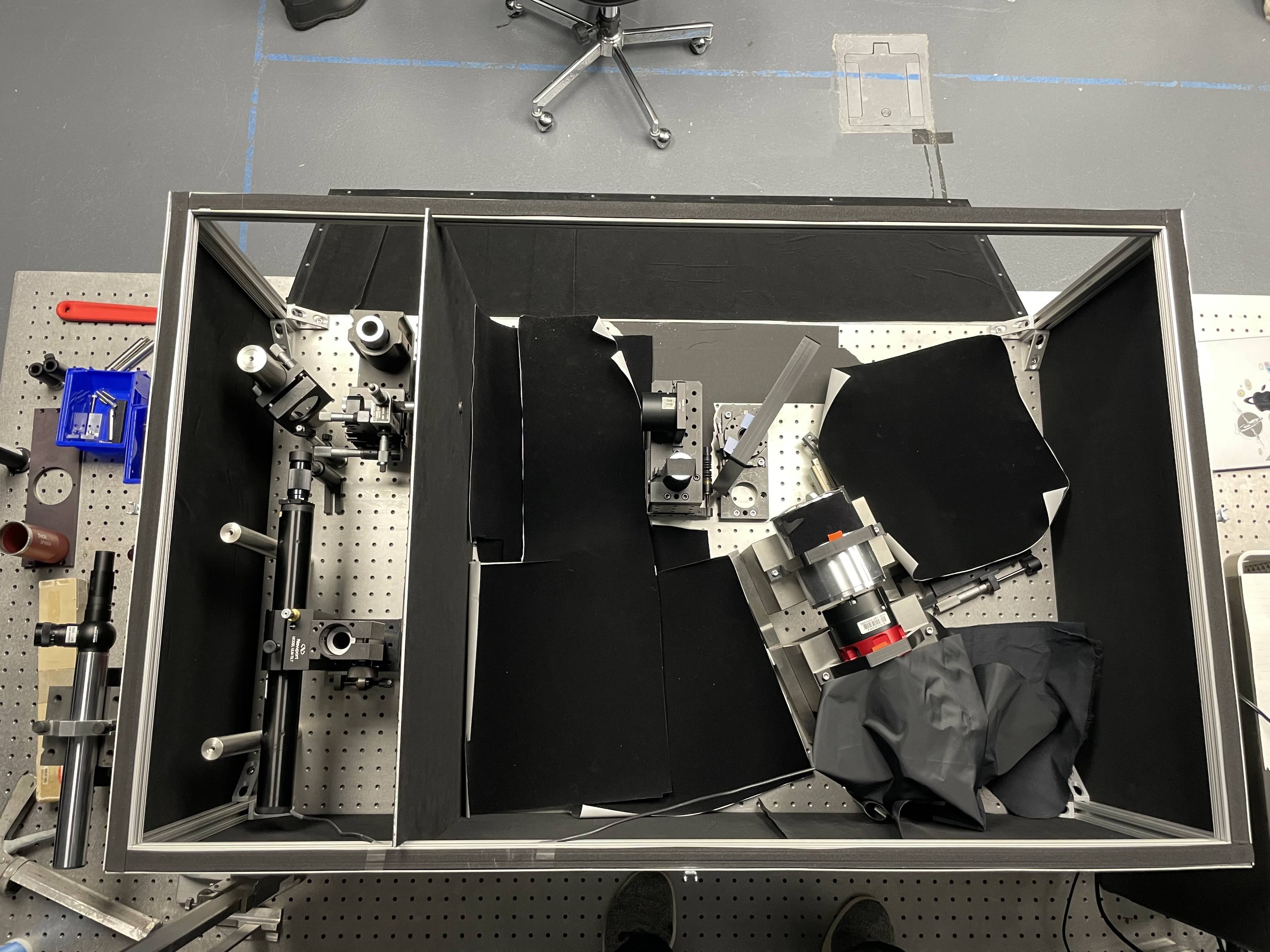 Photo of the full spectrograph setup. From left to right: laser light source, collimator, binary diffraction grating, and CMOS camer.
False Planets around Giant Stars: A Case Study of Sanders 364 in M67
Discovering planets in sparsely populated regions of parameter space is crucial to improving our understanding of planetary formation and evolution. One such region is the subset of planets that orbit giant, evolved stars. However, some evolved stars are known to exhibit quasi-periodic radial velocity (RV) signals, which can masquerade as signals from planetary companions. Using the K giant star Sanders 364 as a case study, we investigate the nature of long-period non-planetary RV signals. The results from our study of Sanders 364 suggest that the detection of true orbital motion from a long-period planetary companion requires extra care when the host star is highly evolved.